1

The way of a man — Story, Setting & Ideas
7
1
Project Gutenberg
2025
Feminism -- Fiction; Man-woman relationships -- Fiction; New York (N.Y.) -- Social life and customs -- 20th century -- Fiction; Sexual freedom -- Fiction; Women editors -- Fiction
Readers of public-domain and historical texts
Project Gutenberg digital edition
en
Edition facts
Words: 61,735
Reading time: 269 min
Text sections: 30
Source:
Project Gutenberg record #76399
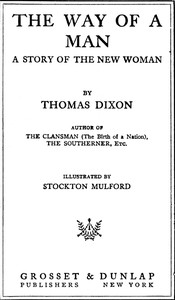
Thomas Dixon's 1919 novel follows Ellen West, a feminist editor in New York, and her relationships with men who represent money, dreams, and tradition. The excerpts reveal a battle over marriage, property, and freedom, with vivid scenes of physical comedy and ideological sparring.
Editorial Edition Score
4.8/5
★★★★★
★★★★★
Calculated from edition completeness, EPUB availability, text structure and catalogue metadata. Not a user rating.
Edition quality
The novel opens with a comic set piece: guests climbing five flights of stairs to Ellen West's apartment, a deliberate test of endurance. Randolph Field, the author-neighbor, carries a protesting woman up the stairs, establishing a tone of playful physicality that recurs throughout. The setting—a walk-up on Fifth Avenue overlooking Madison Square—immediately signals Ellen's pride in her "splendid body" and her rejection of convenience. The early chapters introduce a triangle of suitors: a man of money, a man of dreams, and a man of tradition, each embodying a different vision of marriage. Dixon's prose mixes social commentary with theatrical dialogue, as characters debate the meaning of freedom, property, and love.
The Staircase as a Stage
The opening chapter, "The Festival of Eve," uses the apartment's stairs as a recurring motif. Ellen watches male escorts perspire as they climb, and one bald admirer gives out entirely. This physical challenge is not mere decoration; it establishes Ellen's control over her space and her body. The stairs become a barrier that separates the worthy from the unworthy, and a source of humor. When Randolph Field carries Lucy Sheldon up, the act is both chivalrous and mocking. The staircase reappears later as a symbol of the effort required to reach Ellen's world—a world she owns, as she reminds her lover: "Clark used to pay the taxes, but I own it." The vertical setting reinforces the novel's concern with elevation, both literal and social.
The Blood-Red Negligee and the Eagle's Nest
In a later excerpt, Ellen appears in a "dark, blood-red negligee trimmed in black fur" while serving tea to her lover. The description emphasizes her "sinuous grace" and "stunning beauty," but the scene quickly turns to argument. She insists that marriage would turn furniture into "links in the chain that bind two slaves to eternal servitude." Her lover counters with a vision of domestic intimacy: "the sweet intimacy of this life within the prison of four walls." The setting—a rustic cabin she calls an "eagle's nest in the tree-top"—underscores the tension between freedom and enclosure. Dixon uses the contrast of the blood-red robe and the mountain air to dramatize the conflict between sensual attraction and ideological resistance.
The Language of Property and Personhood
Ellen's dialogue repeatedly frames relationships in terms of ownership. She refuses to be "classed as your property, your home, your ox, your ass," a biblical echo that links marriage to servitude. Her lover, in turn, speaks of kissing "the chain which bound you to me." The novel's catalog subjects—feminism, man-woman relationships, sexual freedom—are enacted through these verbal duels. Dixon gives Ellen a sharp, declarative voice: "a woman who has once felt the throb of a conscious free soul cannot allow herself to be classed." The excerpts do not reveal whether she relents, but the pattern of argument suggests a sustained debate about autonomy and attachment.
The Author as Character and Observer
Randolph Field, the author who lives next door, serves as a commentator and participant. He announces guests with theatrical flair, carries Lucy up the stairs, and later appears in the cabin scene. His profession—he is an author—mirrors Dixon's own, and his role as a neighbor allows him to observe Ellen's life without being a primary suitor. The excerpts show him acting as a kind of master of ceremonies, introducing characters and defusing tension with humor. His presence raises questions about the relationship between the author and his creation: is Field a stand-in for Dixon, or a foil? The text does not clarify, but his function as a witness to Ellen's experiments in living gives the novel a layered perspective.
Readers approaching The Way of a Man should attend to the physical details—the stairs, the negligee, the rustic furniture—as much as the ideological arguments. Dixon builds his debate about the "new woman" through concrete scenes of domestic life, not abstract treatises. The excerpts suggest that the novel's interest lies less in resolving the conflict than in staging it repeatedly, with variations in setting and tone. A first reading might track how each male character's response to Ellen's independence reveals his own limitations, and how the setting itself—city apartment or mountain cabin—shapes the terms of their struggle.
Reader reflection
Before you leave, reflect on the book
Use these questions to collect your thoughts before moving on.
Your progress
0
/
10
2
Did this book hold your interest?
3
How likely are you to recommend this book?
4
What was the reading difficulty like?
5
How clearly were the main ideas presented?
6
What did you appreciate most?
7
How closely did the book connect with your experience?
8
Would you read this book again?
9
What did this book teach you most?
10