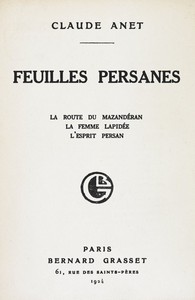
Feuilles persanes; La route du Mazandéran, La femme lapidée, L'esprit persan
Claude Anet's Feuilles persanes isn't one story, but three distinct slices of Persia (modern-day Iran) in the early 20th century. He stitches them together like a careful observer's notebook.
The Story
The first part, La route du Mazandéran, is a straight-up travel adventure. Anet takes us with him on a perilous journey through the Alborz mountains. It's all about the physical challenge, the stunning landscapes, and the people he meets along the way. Then, in La femme lapidée, the tone shifts dramatically. Here, Anet investigates a real event: the stoning of a woman accused of adultery. He pieces together the facts and the social climate that led to her execution, writing with a journalist's eye and a humanist's heart. The final section, L'esprit persan, steps back. It's his attempt to analyze and define the national character—the love of art, the complex social codes, the philosophical outlook—that he encountered everywhere.
Why You Should Read It
What makes this book special is Anet's honesty. He's fascinated by Persia, but he never claims to be an expert who 'solved' it. You feel him wrestling with what he sees. The travelogue is exciting, but the middle section on the stoning is what stays with you. It's not sensationalized; it's a sobering look at justice, tradition, and a life brutally ended. He forces you to sit with that discomfort. Then, by ending with his thoughts on the 'Persian spirit,' he admits that for all his observation, some mysteries remain. The book becomes a record of his attempt to understand, not a declaration that he did.
Final Verdict
Perfect for readers who love immersive travel writing or historical nonfiction that doesn't feel dry. If you enjoyed books like In an Antique Land or the works of Ryszard Kapuściński, where the writer's own perspective is part of the story, you'll connect with this. It's also a great pick for anyone curious about Iran's history beyond the headlines, offering a vivid, personal, and sometimes challenging portrait from a unique moment in time.
This text is dedicated to the public domain. Thank you for supporting open literature.