1

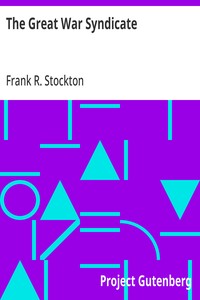
The Great War Syndicate — Edition Insights
(0 User reviews)
3517
Project Gutenberg
1996
Not confirmed
Science fiction
Readers of public-domain and historical texts
Project Gutenberg digital edition
en
Edition facts
Words
39,183
Reading time
171 min
Text sections
4
The Great War Syndicate — Edition Insights can be approached with a clearer sense of reading commitment from its source measurements: 39,183 words, 2 hr 51 min estimated reading time, and 4 detected text sections.
The text analysis averages about 28.8 words per sentence, while the detected sections provide another way to judge how the source is divided.
Project Gutenberg metadata also associates the work with “Science fiction,” connecting these edition facts with the source record’s subject description.
Source:
Project Gutenberg record #427
Frank R. Stockton's 1899 novel imagines a private syndicate using advanced motor-powered weapons and impenetrable armor to fight a naval war between the U.S. and Britain. The opening's fishing dispute, the syndicate's secretive formation, and the climactic battle between the Repeller No. 7 and the HMS Adamant illustrate a speculative military-industrial approach to conflict.
Read the complete public-domain text at its original source.
Read on Project GutenbergThe novel opens with a precise geopolitical trigger: a fishing schooner, the Eliza Drum, is seized by a British cruiser near Newfoundland after a dispute over the three-mile limit. The American cruiser Lennehaha threatens to block the capture, and the standoff escalates through measured, legalistic dialogue—"if he took the Eliza Drum into a Canadian port, he would first have to sail over his ship." This initial incident, grounded in late-nineteenth-century tensions over fishing rights, sets the stage for a war that soon moves beyond conventional naval tactics.
Stockton quickly shifts from this realistic premise to a speculative solution: a private syndicate of capitalists and engineers who develop revolutionary motor-powered weapons and spring-armored vessels. The excerpts show the syndicate's methodical approach—testing their inventions against the mightiest British battleship, the Adamant, whose guns prove useless against the repeller's armor. The narrative thus balances a documentary tone about international law with the fantastical technology of "instantaneous motor-bombs" and submerged "crabs."
From Fishing Dispute to Syndicate Warfare
The opening chapters establish a credible political crisis through the Eliza Drum incident, where both sides cite nautical miles and legal precedent. The American captain's threat to "sail over" the British ship echoes the era's sabre-rattling. However, Stockton undercuts this realism by introducing the Great War Syndicate—a private corporation that takes over the war effort. The syndicate's formation is described in businesslike terms: its members "studied and worked by day and by night" and "poured out their millions." This merger of commerce and combat is the novel's central conceit, and readers should note how the syndicate's profit motive is never questioned, only its effectiveness.
The Repeller and the Adamant: A Test of Armor
The middle excerpts detail the confrontation between Repeller No. 7 and the British ironclad Adamant. Stockton emphasizes the repeller's passive defense: it "sustained the heavy fire" for half an hour to prove its armor's strength. The Adamant's six guns, each "weighing more than a hundred tons," are rendered useless. The narrative then shifts to the submerged crab vessel towing the Adamant stern-first, a slow process because of a ram extending "many feet under water." These technical details—the ram's danger, the spring armor's resilience—ground the fantastical weapons in quasi-engineering logic. The British refusal to surrender, even when helpless, introduces a stubborn honor that contrasts with the syndicate's efficiency.
Motor-Bombs and the Limits of Power
When the Adamant continues firing, the repeller deploys its "motor gun" against the boom suspending the British cannon. Stockton distinguishes between "instantaneous motor-bombs" and a "heavy solid shot, driven by an instantaneous motor attachment." This technical distinction matters: the motor-bomb is a new weapon, but the solid shot is a conventional projectile with a new propulsion system. The excerpt notes that "the instantaneous motor-power had not yet been used at so great a distance," hinting at untested limits. Readers should watch how the syndicate's technology is portrayed as powerful but not omniscient—the crab's officer worries about "constant pounding" damaging his vessel, and the repeller's director must calculate range and trajectory.
Voice and Structure: Documentary vs. Dramatic
Stockton's prose is notably flat and expository, even during battle scenes. He describes the Adamant's armament with catalog-like precision—"six great guns, each weighing more than a hundred tons"—and the syndicate's actions with passive constructions: "it was considered that the strength of her armor had been sufficiently demonstrated." This documentary tone creates a sense of detached observation, as if the reader is reading a report rather than a novel. Yet the structure is dramatic: the opening fishing dispute, the syndicate's secret preparations, and the set-piece battle form a clear arc. The excerpts do not reveal the war's outcome, but the focus on proving superiority suggests that victory is defined by demonstration, not destruction.
As you read, attend to how Stockton balances the syndicate's technological marvels with the stubborn human elements—the British captain who refuses to surrender, the careful calculations of distance and armor. The novel's interest lies less in character than in the mechanics of a war run by a corporation. The excerpts offer a complete microcosm: a crisis, a solution, and a test. The ending, though not shown here, likely hinges on whether the syndicate's proof of superiority translates into actual victory, or whether the old powers of honor and stubbornness prevail.
There’s something strangely tender about Stockton’s confidence in machinery, that a private syndicate could simply end a war. It feels like an old, hopeful dream. I found myself carrying that mood into The World Peril of 1910 — Reading Notes, where the same era’s anxieties turn sharper, less certain. Both books whisper about control slipping away, though only one seems to miss the quiet before it vanished.
There are no reviews for this eBook.
There are no comments for this eBook.
Reader reflection
Your personal reading reflection
Build a private reading journal entry for this title.
Your progress
0
/
10
2
Did this book hold your interest?
3
How likely are you to recommend this book?
4
What was the reading difficulty like?
5
Would this book work well in a reading group?
6
Did this book create an emotional response?
7
Do you expect to return to this book?
8
Was the book what you thought it would be?
9
In one sentence, what did you learn?
10