1

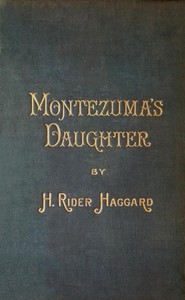
Montezuma's Daughter — Reading Notes
(0 User reviews)
400
Project Gutenberg
2006
Not confirmed
Mexico -- History -- Conquest, 1519-1540 -- Fiction
Readers of public-domain and historical texts
Project Gutenberg digital edition
en
Edition facts
Words
155,362
Reading time
676 min
Text sections
43
Montezuma's Daughter — Reading Notes can be approached with a clearer sense of reading commitment from its source measurements: 155,362 words, 11 hr 16 min estimated reading time, and 43 detected text sections.
The text analysis averages about 23.9 words per sentence, while the detected sections provide another way to judge how the source is divided.
Project Gutenberg metadata also associates the work with “Mexico -- History -- Conquest, 1519-1540 -- Fiction,” connecting these edition facts with the source record’s subject description.
Source:
Project Gutenberg record #1848
H. Rider Haggard's Montezuma's Daughter follows Thomas Wingfield's narration of his capture by Aztecs, his role as a living god Tezcat, and his marriage to Otomie. The excerpt shows ritualized worship, blood-soaked priests, and the tension between indigenous religion and Spanish conquest.
Read the complete public-domain text at its original source.
Read on Project GutenbergFrom its opening chapters, H. Rider Haggard's Montezuma's Daughter establishes a first-person narrator, Thomas Wingfield, who recounts his adventures with the deliberate formality of a man setting down a record. The dedication to J. Gladwyn Jebb, referencing shared travels and a hidden treasure, frames the tale as one rooted in personal experience and friendship. The narrative voice is measured, often pausing to describe ceremonies and customs with the eye of an outsider who has become an insider. Wingfield's tone is that of a survivor looking back, not a hero boasting, which gives the prose a reflective, sometimes somber quality.
Ritual and Repetition in the Ceremonial Scene
The excerpt from the wedding ceremony reveals Haggard's careful construction of ritual through repetition and sensory detail. The narrator describes being given two lutes, one in each hand, and being led to the great hall where his four wives stand dressed as goddesses. The wives kiss him on the brow and offer sweetmeats, meal cakes, cocoa, and mescal in golden vessels. The repetition of actions—the wives coming forward one by one, the priest crying aloud three times, the people prostrating themselves three times—creates a hypnotic, liturgical rhythm. Haggard emphasizes the physicality of the scene: the blood on the priests' robes, their matted hair, their red hands. The narrator notes that he drank the mescal for inward comfort but could not touch the other dainties, a small personal detail that contrasts with the grand, public ceremony. The priest's speech, with its elaborate address to the god Tezcat, uses the language of love and intercession even as it prepares for sacrifice. This juxtaposition of affection and violence is central to Haggard's depiction of Aztec religion.
The Narrator's Double Perspective
Thomas Wingfield's narration oscillates between the immediacy of events and the reflective distance of memory. In the ceremonial scene, he observes details with a 'stony wonder,' noting that 'nothing seemed to escape my notice' even in his last hour. This dual awareness—being both participant and observer—allows Haggard to convey the strangeness of the rituals while grounding them in a recognizable human response. The narrator describes the weeping of the people and his wives, except Otomie, who remains composed. This small observation hints at character without explicit commentary. Wingfield's voice is that of an Englishman who has been absorbed into Aztec society but retains his own perspective. He refers to the priests as 'villainous,' a moral judgment that colors the description without overwhelming it. The narrative thus balances ethnographic detail with personal reaction, creating a layered account of cultural encounter.
Juxtaposition of Battle and Ceremony
Haggard sets the ritual procession against the backdrop of a raging battle. The narrator describes the attack on the palace of Axa, where Spaniards and Tlascalans fight Aztec warriors. The juxtaposition is stark: 'Five hundred yards away or so, raged this struggle to the death, but about me, around the gates...' the ceremony proceeds. This spatial contrast heightens the tension, as the reader is aware of the violence that surrounds the ritual. The priests lead the narrator toward the great teocalli, where he must 'give up the ghost,' while arrows and javelins pour into the Spanish quarters. The ceremony is not isolated from the war; it is part of it, a religious act performed in the midst of a siege. Haggard uses this juxtaposition to underscore the precariousness of Wingfield's position and the intertwining of faith and conflict in the Aztec world. The battle noise and the ritual chants coexist, creating a dense, layered soundscape.
Diction and the Language of Worship
The priest's address to Tezcat is a set piece of formal, supplicatory rhetoric. Phrases such as 'Forgive us, O Tezcat,' 'you know how sore is the strait of your servants,' and 'intercede for us, we beseech you' mimic the language of Christian prayer, yet they are spoken by a priest of a different religion. Haggard's choice to render the speech in elevated English gives it a solemn, almost biblical tone, which may reflect the narrator's translation or memory of the event. The priest speaks of the god's 'longing to pass beyond the skies' and of human prosperity as 'a shadow which flees away,' blending Aztec cosmology with a universal theme of transience. The repeated use of 'O Tezcat' and the collective self-identification as 'your little children' creates a relationship of dependency and devotion. This diction, while invented, conveys the gravity of the ritual and the sincerity of the worshippers, even as the narrator distances himself from their beliefs.
Readers attentive to Haggard's craft will notice how he uses the narrator's voice to mediate between two worlds. The ceremonial scene, with its precise choreography and emotional undercurrents, rewards close reading for its structural parallels and contrasts. The battle that frames the ritual is not merely background but an active force that shapes the ceremony's meaning. Wingfield's account invites scrutiny of how memory, translation, and personal bias color the telling of cross-cultural encounters.
That gray afternoon, I sat with Montezuma’s Daughter and felt the weight of Thomas's double life—god and captive—until the rain blurred the window glass. His quiet dread of being unmasked stayed with me long after I closed it. Later, almost by accident, I found The trail of deception — Themes and Context, and the same thin line between belief and betrayal seemed to haunt its pages too.
There are no reviews for this eBook.
There are no comments for this eBook.
Reader reflection
What did you think of this book?
Answer a few questions and save a private reflection on this device.
Your progress
0
/
10
2
How much did you enjoy the reading experience?
3
How likely are you to recommend this book?
4
Did the language feel accessible?
5
Did the story or argument move comfortably?
6
How original did the book feel?
7
Would this book work well in a reading group?
8
Was the book what you thought it would be?
9
Which lesson or insight stayed with you?
10