1

The trail of deception — Themes and Context
(0 User reviews)
684
Project Gutenberg
2025
Not confirmed
Western stories; Inheritance and succession -- Fiction; Impostors and imposture -- Fiction; Adventure stories; Mystery fiction; Ranch life -- Fiction; Wills -- Fiction
Readers of public-domain and historical texts
Project Gutenberg digital edition
en
Edition facts
Words
27,748
Reading time
121 min
Text sections
3
The source record for The trail of deception — Themes and Context measures this digital text at 27,748 words, 2 hr 1 min estimated reading time, and 3 detected text sections.
The text analysis averages about 11.4 words per sentence, while the detected sections provide another way to judge how the source is divided.
Project Gutenberg metadata also associates the work with “Western stories,” connecting these edition facts with the source record’s subject description.
Source:
Project Gutenberg record #77016
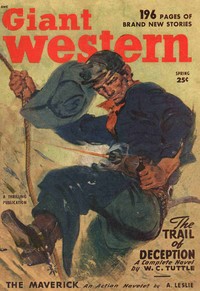
W. C. Tuttle's western mystery follows Jim Bailey, a broke bookkeeper who fakes his death to escape debt and inherits a ranch, only to face impostors, rustlers, and a lawyer's scheme. The prose blends deadpan humor with clipped dialogue and vivid ranch life details.
Read the complete public-domain text at its original source.
Read on Project GutenbergW. C. Tuttle opens The Trail of Deception with a bookkeeper down to his last two dollars, a note from his landlady demanding back rent, and a roommate who has just stolen his best suit and watch. The scene on a park bench, with blinking lights and a young man "trying to buck the world," establishes a tone of wry, understated desperation. Tuttle's diction favors colloquial bluntness—"that doggone chiseler"—and his dialogue often lands as dry repartee, as when a deputy sheriff asks a rattled Jim Bailey whether the rustlers' horses were pink. These early choices signal a story that will balance hard-boiled plotting with a comic, almost self-deprecating voice.
A Voice of Deadpan Exasperation
Jim Bailey's narration carries a weary, sardonic edge that sets the book apart from straight-faced westerns. When he finds his roommate's note—"Sorry, old man, but I had to put on a little dog"—his reaction is not rage but a kind of resigned disgust: "It was like Cliff to do a thing like that." Tuttle lets the humor sit in the gap between Jim's predicament and his understated response. Later, after a violent encounter with rustlers leaves Jim sore and horse-less, the cook Tellurium deadpans: "He's shore hard on the rollin' stock of this here ranch." The dialogue among the ranch hands—Cactus, Tellurium, and Jim—trades in a shared, laconic wit that never breaks character. Even a snake, according to Tellurium, took one look at Jim and said, "No use strikin' at him, 'cause he's too blamed fast." These exchanges do not merely lighten the mood; they define a community that processes danger through understatement.
Clues in the Cadence of Speech
Tuttle distinguishes characters by their verbal tics and rhythms. Ed McLean, the lawyer, speaks in clipped, calculating phrases: "What's your price, Smith?" and "I don't dare tell Bailey. He'd get so frightened he'd leave." His words reveal a man who measures every utterance for leverage. Skeeter Smith, by contrast, drawls with a lazy confidence that masks his scheming: "I can ruin yore deal, McLean. And don't try any funny stuff." The ranch cook Tellurium and deputy Cactus Spears share a folksy, almost vaudevillian banter—"Pink?" "Why not green?" "Not this time of year"—that signals their role as comic foils. Jim Bailey's own voice shifts from the city-bred exasperation of the opening chapters to a more laconic tone as he adapts to ranch life. These vocal fingerprints allow the reader to track alliances and deceptions without relying on explicit exposition.
The Weight of Small Details
Tuttle builds the world of the Lazy H ranch through precise, unglamorous particulars. Jim's swollen feet are encased in "a pair of Tellurium's old slippers." The missing horse is named Blondy; another is called Peter the Hermit. When Jim rides into town, he goes in a "ranch buckboard" because he cannot sit a saddle. These details are not decorative—they anchor the story in a specific, tactile reality. The lawyer's office has a desk, a rear entrance, and a small stable with a buggy horse that can also be saddled. The Antelope Saloon provides the only named landmark in town. Tuttle avoids romanticizing the setting; instead, he populates it with worn objects and practical arrangements. Even the rustlers' horses are discussed not for their beauty but for their color—a detail Jim cannot recall, to Cactus's comic frustration. This accumulation of small, concrete facts gives the mystery a grounded, credible texture.
Structure and the Unreliable Inheritance
The plot hinges on a will, an impostor, and a presumed death—but Tuttle withholds the full mechanics of the deception. From the excerpts, Jim Bailey is reported dead early on, which "gave him a clear field for a profitable game." Yet the reader sees only fragments of the scheme: a lawyer named McLean who fears exposure, a cowboy named Skeeter who demands a cut, and a deputy who questions Jim about horse colors. Tuttle parcels out information through oblique dialogue and partial scenes. McLean mutters to himself, "If anybody thinks he can stop me from making this deal—let him try," but the exact nature of the deal remains unclear. The narrative trusts the reader to piece together motives from behavior rather than confession. This structural restraint—showing characters acting on incomplete knowledge—mirrors Jim's own confusion and keeps the mystery alive without relying on a single omniscient viewpoint.
Readers coming to The Trail of Deception should attend to what characters do not say. Tuttle's dialogue is a game of implication: a pause, a grin, a muttered aside often carries more weight than a direct statement. The humor, too, is a clue—it signals which characters are at ease and which are performing. Pay attention to the horses, the slippers, the buckboard; these objects are not props but evidence of a world where deception leaves material traces. The story rewards a patient, observant reading.
There’s something about Jim Bailey's quiet, stubborn scramble to outrun his own name that lingers, like the smell of saddle leather after rain. It made me think of the old romances, where justice hides in shadowed rooms. One such story, The Star-Chamber: An Historical Romance, Volume 2 — Edition Insights, carries that same patient weight of secrets waiting to be told. Some trails just lead to older truths.
There are no reviews for this eBook.
There are no comments for this eBook.
Reader reflection
Take a moment to reflect on this book
Create a short personal record of your experience with this book.
Your progress
0
/
10
2
Did this book hold your interest?
3
Would you encourage someone else to read it?
4
Did the language feel accessible?
5
How would you rate its originality?
6
Did the book deliver what you hoped for?
7
Would you start a conversation about this book?
8
Do you expect to return to this book?
9
What changed or sharpened your thinking?
10