1

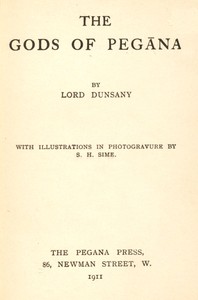
The Gods of Pegana — Themes and Context
(0 User reviews)
345
Project Gutenberg
2005
Not confirmed
Fantasy fiction, English
Readers of public-domain and historical texts
Project Gutenberg digital edition
en
Edition facts
Words
19,268
Reading time
84 min
Text sections
34
The source record for The Gods of Pegana — Themes and Context measures this digital text at 19,268 words, 1 hr 24 min estimated reading time, and 34 detected text sections.
The text analysis averages about 25.5 words per sentence, while the detected sections provide another way to judge how the source is divided.
Project Gutenberg metadata also associates the work with “Fantasy fiction, English,” connecting these edition facts with the source record’s subject description.
Source:
Project Gutenberg record #8395
Lord Dunsany's invented mythology of Pegana, where the sleeping god MANA-YOOD-SUSHAI dreams worlds into being through Skarl's drumming, unfolds in a series of prose poems and parables about gods, prophets, and the inexorable forces of time and death.
Read the complete public-domain text at its original source.
Read on Project GutenbergThe preface immediately establishes a tone of cosmic uncertainty: before THE BEGINNING, Fate and Chance cast lots, and the winner commanded MANA-YOOD-SUSHAI to make gods. Who won—Fate or Chance—is left unknown. This opening frames the entire work as a mythology built on deliberate gaps, where origins are hinted but never fully explained. The introduction then declares that MANA-YOOD-SUSHAI made the gods and rested, and that at the Last he will forget to rest and destroy them. This cyclical structure—creation, rest, destruction—gives the reader a clear arc from the first page.
The first chapter, "Of Skarl the Drummer," shows how the gods' existence depends on Skarl's perpetual drumming, which lulls MANA-YOOD-SUSHAI to sleep. Worlds and suns may be echoes of that drum or dreams arising in the god's mind. The prose is rhythmic and incantatory, matching its subject.
The Gods as Forces, Not Characters
The excerpts present gods like Mung, Sish, and Kib not as personalities with motives, but as embodiments of natural or metaphysical forces. Mung is the god of death, Sish of time, Kib of knowledge. Their actions are described in stark, repetitive patterns: Mung treads in gardens at night, Sish hurls Time and slays Hours. The chapter "The Deeds of Mung" shows the prophet Kabok's three-night ordeal: each night Mung treads closer, and each morning Kabok rationalizes the threat. This structure—three nights, growing dread, inevitable end—recurs throughout the excerpts, suggesting a ritualistic narrative logic. Readers should expect gods to act according to their nature rather than through dialogue or internal conflict.
Prophets and Their Fates
The excerpts trace a pattern of prophets who challenge or fear the gods. Kabok, who knows All Things, initially dismisses Mung's treading, then flees and is consumed. Yun-Ilara, who has no fear of Mung, builds a tower and curses the god daily, yet Mung never answers—instead, Sish ages him until he finally praises Mung as "loveliest of the gods." This reversal suggests that defiance is futile, but the text does not moralize; it simply records the outcome. The prophets' stories are not parables with clear lessons but episodes in a larger, indifferent cosmology. The reader is left to observe the symmetry: Kabok's fear leads to his end; Yun-Ilara's fearlessness leads to a different kind of submission.
Repetition and Variation in Structure
Dunsany's prose relies on repeated phrases and parallel constructions. In "Of Skarl the Drummer," the phrase "and there fell a hush upon the gods" echoes the silence that follows MANA-YOOD-SUSHAI's sleep. In "The Deeds of Mung," the refrain "Mung trod again in the garden of Kabok" builds tension through exact repetition. Yet variation occurs: the third night adds "towards Kabok's door" and the sign of Mung. Similarly, Yun-Ilara's curses shift from defiance to praise. This technique gives the text a liturgical quality, as if the reader is witnessing a ritual. Pay attention to what changes and what stays the same across chapters—these patterns often signal the key thematic shifts.
The Role of the Unknowable
Throughout the excerpts, the ultimate source of reality—MANA-YOOD-SUSHAI—remains inaccessible. No one prays to him; only the gods may do so. His drummer Skarl sits on mist before his feet, but "who hath heard the voice of MANA-YOOD-SUSHAI, or who hath seen his drummer?" The preface's unanswered question about Fate and Chance reinforces this. The gods themselves are limited: they act within a framework they did not create. This creates a layered cosmology where even the gods are not omniscient. Readers should not expect a revealed truth or a clear hierarchy; instead, the text invites contemplation of what lies beyond the known gods—the "Thing That Is Neither God Nor Beast" mentioned in one chapter title. The gaps are as significant as the stories.
Because The Gods of Pegana is a collection of short, self-contained chapters rather than a continuous narrative, readers may approach it as a series of mythological vignettes. Each chapter can be read independently, but recurring names and patterns reward sequential reading. Pay attention to the chapter titles: they often announce the subject ("Of Skarl the Drummer") or the structure ("The Sayings of Kib"). The prose is dense and poetic; reading aloud may reveal its rhythmic qualities. No single chapter explains the whole cosmology, so let the fragments accumulate.
Reading about Skarl endlessly drumming the worlds into being brought back the hush of my grandfather’s study, where the dust motes danced. I remember lingering over the slow, green journey in The Wood Beyond the World — Reading Companion, feeling that same strange patience. There, too, a single walk seemed to hold all of time, almost like a dream that waited for me to wake.
There are no reviews for this eBook.
There are no comments for this eBook.
Reader reflection
Your personal reading reflection
Build a private reading journal entry for this title.
Your progress
0
/
10
2
Did this book hold your interest?
3
Would you encourage someone else to read it?
4
What was the reading difficulty like?
5
Did any part of the book feel personally relevant?
6
Is this a title worth rereading?
7
How useful were the ideas in this book?
8
How distinctive were its ideas or approach?
9
What changed or sharpened your thinking?
10